

Space Requirements of a Packaging Line: Eight Factors That Are Often Underestimated
The machine footprint alone is only part of the picture. The actual space requirement results from several factors that are easily overlooked during early planning:
- Building restrictions: Columns, ceiling height, floor load capacity, gates, and escape routes are non-negotiable. Especially for installations on upper floors, floor load capacity can become the limiting factor.
- Upstream and downstream processes: Ovens, cooling lines, coating systems, or deep-freeze areas determine where the product flow begins and ends.
- Material supply and removal: Carton blanks, film rolls, pallets – routes for inbound and outbound transport must be planned.
- Buffer zones and transfer points: Handover areas between upstream processes and the packaging section.
- Format changes and operator access: Anyone who regularly changes format parts (i.e., product-specific changeover parts) – for example due to increasing product variety or changing private-label orders – needs clear access and storage space.
- Utility infrastructure: Compressed air, electrical supply, extraction – routing determines machine positions.
- Hygiene separation and zoning: Defined transitions, airlocks, or spatial distances between hygiene zones – especially in food production.
- Scalability: If the line will be expanded later or new formats added, the layout should already include reserves today.
The Central Trade-off: Compactness vs. Accessibility
Building compact sounds appealing. But anyone who minimizes space requirements too aggressively pays the price in daily operations. Maintenance access becomes tight, format changes take longer, and cleaning becomes more complex. As Markus Vogelmann, Sales Engineer at Schubert, puts it: "Compactness can be an advantage – or it can conflict with machine accessibility. You always have to weigh how compact a machine should be built so that it still makes sense in operation."
Anyone looking to plan a compact packaging line must honestly weigh both requirements against each other – to avoid discovering during installation that a control cabinet is blocking a column. Especially when frequent format changes are part of everyday operations, a well-thought-out operator concept becomes a real productivity factor.
Quick Overview: TLM, Lightline, and Tog
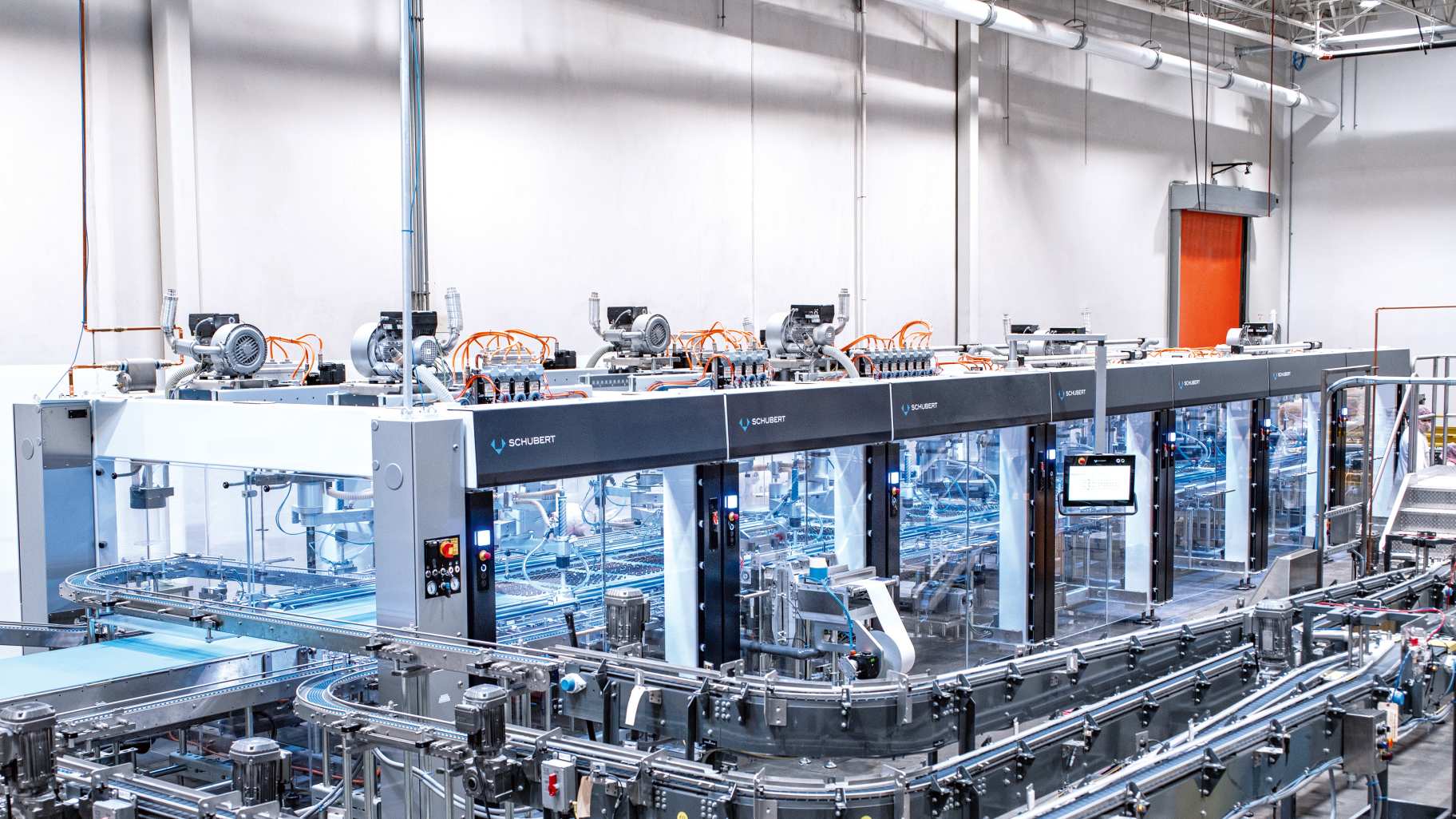
We offer three product families, each designed for different packaging requirements: TLM systems (Top Loading Machines) stand for maximum performance – highly flexible, modular packaging solutions for demanding integrated processes across primary, secondary, and tertiary packaging. Lightline offers a fast entry into automated packaging: pre-configured standard machines, compact in design and reduced to the essentials – ideal for packaging tasks that require less flexibility in the packaging process. The Tog series stands for unrestricted adaptability: 100% standardized production cells, each covering only one function in the packaging process (e.g., carton erecting or pick-and-place), can be networked into a flexible overall system, creating a maximally adaptable production setup.

Layout Planning with Schubert: How We Support You from the Start
At Schubert, layout planning is not an afterthought – it is an integral part of every project from the very beginning. From the first conversation, our sales engineers think ahead: What does the facility look like? Where are the columns, where do utility lines run? Which upstream and downstream processes need to be connected? Are there hygiene zones that must be considered?
Our goal is not simply to deliver a machine, but to work with you to develop a solution that fits your production – spatially, process-wise, and economically. So that an investment in new packaging technology delivers sustainable results in the long term.
Checklist: Five Points for Your Layout Planning
- Document building restrictions – Record columns, ceiling height, floor load capacity, gates, and escape routes.
- Include upstream and downstream processes – Where does the product flow begin and end? Which hygiene zones apply? What does the logistics process look like for this project?
- Think material flow holistically – Include supply, removal, and buffer zones in the floor space planning.
- Check scalability – Is there enough space for new formats or future expansions?
- Start the dialogue early – The sooner machine builders and planners look at the floor plan together, the better the result – ideally during the concept phase, before facility plans are finalized.
Next Step
Are you planning a new packaging line in an existing production facility and want to know what's possible in your space? In a free, no-obligation initial consultation, we'll review your situation together – and clarify what options your space offers.
Frequently Asked Questions About Layout Planning with Limited Space
How much space does a packaging line require?
The space requirement depends not only on the machine footprint but on factors such as building restrictions, material flow, operator access, hygiene zones, and scalability.
Can a packaging line be integrated into an existing facility?
Yes – through individual layout planning, modular machine design with flexible frame sizes, and the selection of the right robot technology, packaging lines can also be realized in existing buildings.
What if there isn't enough floor space for a complete packaging line?
Then it's worth looking at machine concepts specifically designed for compact construction. Our Lightline series, for example, offers pre-configured standard machines for typical packaging tasks such as cartoning, case packing, or palletizing – built to save space and ready for quick deployment. This way, a reliable entry into automated packaging can be achieved even on limited floor space.
How early should the machine builder be involved in layout planning? Ideally during the concept phase, before facility plans are finalized. The earlier, the better the result.